
Lawn tips & guides
Getting Crispy: Why the Edge Is the First Thing People Notice
· 5 min read · Boss Mowing crew
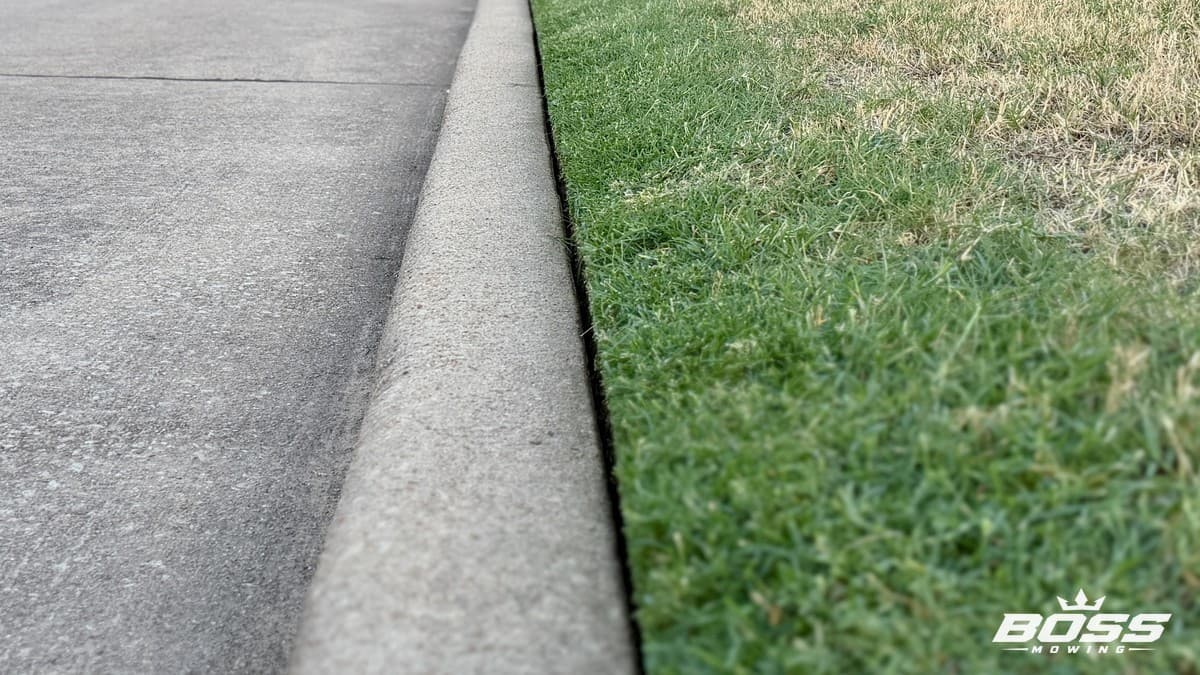
A cut line, not a trim
Look closely at the photo above. That isn't grass that's been shortened near the concrete — it's grass that's been cut straight down, leaving a clean vertical face and a dark gap where the blade went in. Run your finger along it and you can feel the drop.
That's edging. String trimming is a different job: it knocks the height down around obstacles so nothing is left standing. Edging cuts the boundary itself, vertically, so the turf stops exactly where the concrete starts. Most lawns get trimmed and never edged, which is why they look almost right and not quite finished.
It is also the single cheapest thing that makes a yard look professionally maintained. Two houses can be cut to the same height on the same day, and the one with edged walks will look like it costs more to look after.
Why bermuda makes this an Oklahoma problem
Bermuda spreads by stolons — runners that creep sideways across the surface, rooting as they go. That's what makes it tough enough to survive an Oklahoma summer, and it's exactly what sends it out over your driveway.
Left alone, those runners reach across the concrete a little further every week. Within a season the hard edge has disappeared under a soft fringe of grass, the walk looks narrower than it is, and soil starts collecting in the gap. Within a few seasons you get a genuine lip — turf growing up and over — and getting it back means cutting through matted runners and built-up dirt rather than just grass.
Fescue does this far less, which is why a lawn up north can go years looking tidy without a dedicated edge. In bermuda country it's maintenance, not decoration.
What the gap is actually doing
The dark line beside the concrete isn't only cosmetic. It gives water somewhere to go, so runoff follows the edge instead of pooling against the slab and pushing soil onto the walk.
It also gives the next cut something to register against. Once a true edge exists, keeping it is a pass with the blade. Once it's gone, restoring it is a proper job — which is why the first edge on a neglected lawn takes far longer than every one after it.
How often it needs doing
Through the growing season — roughly April to September here — bermuda puts out enough runner growth that an edge softens in two to three weeks. We cut it every visit, so it never gets the chance.
That's deliberate. Edging every time is a couple of minutes per property. Edging once a month means fighting the runners back each time, and the line is never as sharp because there's always a little more to remove than there should be.
Through the dormant months there's nothing to cut. The edge you take into November is the one you'll still have in February, which is another argument for finishing the season properly.
Where the edge belongs
Driveways and sidewalks are the obvious ones, and they're what people see from the street. Curb lines matter as much and get skipped most often — a crisp curb is what makes a whole street of lawns look cared for.
Beds are the other one. A cut-in edge between turf and mulch stops bermuda invading the beds, which is a far harder problem to fix than a ragged line. If you've ever pulled runners out of a flower bed by hand, you already know why.
The honest version
Edging adds a few minutes to every visit and it's one of the first things a cheaper crew drops to fit more stops into a day. It doesn't make the grass healthier and it won't help your lawn survive August.
What it does is make the difference between a lawn that's been mown and a lawn that's been finished. That's the whole argument, and it's why we do it every time rather than when someone asks.
Rather have it handled?
Trace your lawn on the aerial map and get a real price in about a minute — or call (580) 304-9976.
Get my instant quote